
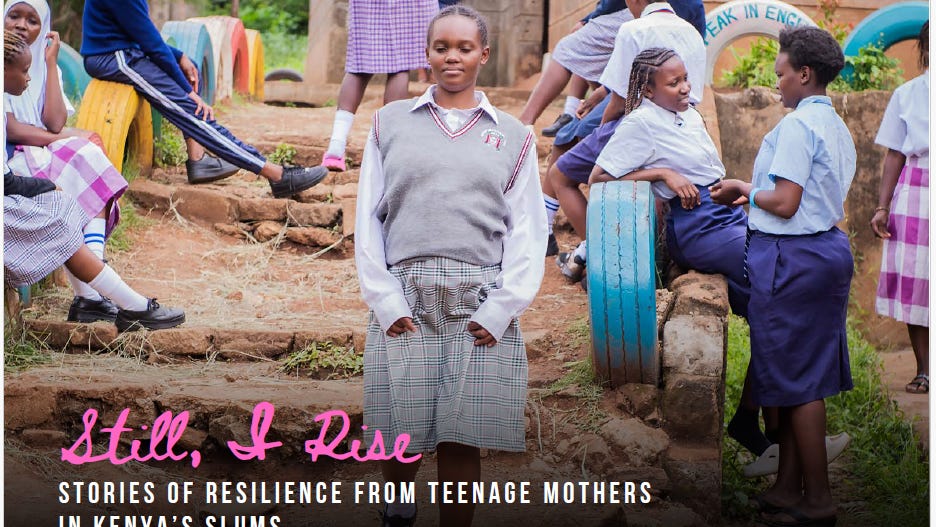

NAIROBI, Kenya — For years, teenage pregnancy in Kenya’s informal settlements has largely been told through statistics: the number of girls leaving school, the rising demand for maternal health services and the social costs of early motherhood.
But a new book is challenging that narrative by allowing 28 young mothers from Nairobi’s informal settlements to tell their own stories of hardship, survival and determination to build better futures, writes Winston Mwale.
Titled Still, I Rise: Stories of Resilience from Teenage Mothers in Kenya’s Slums, the collection brings together first-person testimonies and portrait photography from young women in Kibera, Mathare and Mukuru who have experienced pregnancy and motherhood while navigating poverty, stigma, gender-based violence and disrupted education.
Launched Oct. 10, 2026, in Charlotte, North Carolina, as part of CFK Africa’s 25th-anniversary celebrations, the book shifts attention from the circumstances surrounding teenage pregnancy to the young women themselves — their voices, ambitions and efforts to reclaim control over their lives.
“I refuse to let the label of ‘teen mother’ define me. Because at my core, I know that I am much more than that. I am a strong woman with big ambitions,” writes contributor Hilda Villary, who became a mother at 17 in Kibera.
A Crisis Behind the Numbers
The publication comes against a backdrop of persistent adolescent pregnancy in Kenya.
According to figures cited from the 2026 Kenya Economic Survey, 235,938 girls aged 10 to 19 presented with pregnancy during their first antenatal care visits in 2025.
Among them were 11,605 girls aged 10 to 14, compared with 11,126 recorded the previous year.
The figures underscore the scale of a challenge that extends beyond maternal healthcare to education, child protection, household poverty and gender inequality.
CFK Africa estimates that approximately one in four girls aged 15 to 19 in Kibera has already given birth. Across Kenya, about 13,000 girls reportedly leave school annually because of pregnancy, with only around half returning to complete their education.
For many, pregnancy is followed by family rejection, abandonment by partners, financial insecurity and limited access to reproductive healthcare.
Yet the experiences documented in Still, I Rise demonstrate that early motherhood does not necessarily mark the end of a young woman’s education or aspirations when appropriate support is available.
Stories of Rejection, Courage and Recovery
Organized into four sections — Unmasking Stigma, Her Right to Health, Shattering Silence and Still Standing — the book explores the overlapping challenges confronting teenage mothers.
The contributors recount experiences of homelessness, discrimination, sexual and domestic violence, difficult pregnancies and the struggle to remain in school while raising children.
Sharon Atuko, who became pregnant at 17, describes being abandoned by her child’s father and forced out of her home by relatives.
She spent nights on the streets before prematurely giving birth to her son, Wilson Jumbe, at 28 weeks.
“Shame, judgment and abandonment followed me like a shadow,” she writes.
Despite those experiences, Atuko identifies an eagle as her personal symbol of resilience, representing her determination to rise above adversity and look beyond her immediate circumstances.
For Fatuma Tadicha, who became a mother at 18 in Mathare, pregnancy exposed the financial barriers facing young women seeking maternal healthcare.
She recounts struggling to obtain an anti-Rhesus injection costing 10,500 Kenyan shillings, alongside experiences of rejection and domestic abuse.
After undergoing an emergency caesarean section at 34 weeks, Tadicha returned to secondary school. She also began selling samosas and cutlery on weekends to meet her transport expenses.
Her ambition is to become a neurosurgeon.
“These days, I dream wildly and fearlessly,” she writes.
Her account illustrates a central message running through the collection: the young women do not want their experiences of adversity to become permanent definitions of who they are.
Other contributors confront the lasting effects of gender-based violence.
Seanice Musashi, who grew up in Mukuru kwa Ruben, recounts surviving a violent assault by three men when she was 16.
She describes the emotional consequences of the attack, the initial disbelief she encountered and how support through CFK Africa’s youth programmes helped her find a voice through advocacy and storytelling.
“Storytelling helps me heal. It gives me strength. When I speak, I feel seen. I feel heard,” she writes.
“My story does not end with what happened to me. I am still here, and this means I am still writing it.”
Turning Personal Testimonies Into Practical Support
Beyond documenting hardship, the book highlights an intervention that is helping teenage mothers resume their education.
The stories emerged from CFK Africa’s Funzo Project, launched in 2018 to address school dropout rates among young mothers.
Derived from the Swahili word meaning “to educate,” Funzo works with schools, community health promoters and healthcare providers to help adolescent mothers overcome barriers to learning.
Its support includes tuition scholarships, mentorship, peer groups and childcare assistance.
According to CFK Africa, the project has helped more than 900 young mothers return to secondary education and currently works with approximately 350 vulnerable adolescent mothers annually.
The organization also operates Tabitha Maternity Home in Kibera, which delivers more than 550 babies each year while providing affordable maternal healthcare.
These services are particularly significant for young women who encounter stigma or mistreatment when seeking medical attention.
Contributor Binti Rashid, a recipient of CFK Africa’s 2025 Pheroze Nowrojee Award for advocacy, recounts leaving a clinic in tears after a negative encounter before receiving support that helped her return to Olympic High School.
Her experience illustrates why improving maternal outcomes requires more than expanding access to clinical facilities. Young mothers also need respectful treatment, psychosocial support and opportunities to continue their education.
A Safe Space to Tell Their Stories
The book took shape during a weeklong writers’ retreat organized by CFK Africa at Lerruat Resort in Kajiado in August 2025.
For almost all 28 contributors, it was their first experience traveling outside Nairobi’s informal settlements.
The retreat provided an environment in which the young mothers could temporarily step away from daily responsibilities and reflect on experiences they had often struggled to discuss openly.
They participated in reflective writing, art therapy and storycloth stitching, supported by mentors and community health promoters.
The process was guided in part by Siama Yusuf, leader of CFK Africa’s Girls’ Empowerment Program and herself a former teenage mother from Kibera.
In the book’s foreword, Yusuf describes growing up in Makina, becoming pregnant at 18, leaving university amid stigma and later raising her child alone.
Her experiences now inform her work supporting girls facing similar circumstances.
“But I did not let my circumstances or societal norms define me,” she writes.
“I found my inner strength and overcame barriers to become who I am today.”
Yusuf’s journey reinforces the importance of involving people with lived experience in designing and delivering interventions intended to support vulnerable communities.
Listening Instead of Speaking for Others
The launch of Still, I Rise also places a spotlight on locally led development and the importance of allowing communities to shape their own narratives.
CFK Africa Chief Executive Officer Jeffrey Okoro said the collection reflects a lesson the organization has learned throughout its 25 years of work.
“We have spent 25 years learning the same lesson over and over. The people closest to a problem already understand it better than anyone arriving with a solution,” he said.
“This book is that idea in its simplest form. We did not tell these stories. We got out of the way so they could be told.”
Actress and UNICEF Goodwill Ambassador Mia Farrow, who endorsed the publication, described it as a necessary collection that challenges readers to move beyond sympathy toward meaningful action.
She said the contributors demonstrate the courage of young people facing extraordinary challenges while reminding society of its responsibility to support them.
Charlotte Barcott, a CFK Africa volunteer who participated in the Kajiado retreat and wrote the book’s afterword, said the project sought to raise awareness of teenage pregnancy and the injustices surrounding it.
She expressed hope that the stories would help other girls experiencing similar difficulties feel less isolated.
Investing in Two Generations
The publication is also intended to generate practical benefits for its contributors.
All proceeds from Still, I Rise will support CFK Africa’s Girls’ Empowerment Program, including full secondary-school scholarships for the 28 young authors and educational support for their children.
The approach recognizes that helping teenage mothers remain in school can improve opportunities for both the young women and the next generation.
Founded in 2001, CFK Africa works across healthcare, education, sports, girls’ empowerment and workforce development.
The organization reports reaching approximately 200,000 young people annually across 26 communities, while its Girls’ Empowerment Program serves about 8,000 girls each year.
The book is dedicated to contributor Wyvienne Sarange, who died unexpectedly on March 27, 2026, at age 18, leaving behind her 2-year-old daughter, Fidelima Blessings.
Her inclusion ensures that her story remains part of the collective testimony of young women determined to be recognized for more than the circumstances of their pregnancies.
For CFK Africa, the publication presents an argument for combining storytelling with tangible interventions: scholarships, safe spaces, mentorship, childcare and accessible healthcare.
It also challenges policymakers, development organizations and communities to reconsider approaches that treat teenage mothers primarily as statistics or recipients of assistance rather than individuals with ambitions and the capacity to shape their futures.
As Yusuf reminds young mothers in the book’s foreword, their circumstances do not define them, and they should not surrender control of their stories.
In Nairobi’s informal settlements, where poverty and exclusion can severely restrict opportunities, the experiences captured in Still, I Rise demonstrate what becomes possible when young mothers receive support to return to school, recover their confidence and pursue their ambitions.
Their message extends beyond resilience: teenage motherhood should not mean the end of a girl’s dreams.